Temperature-responsive Gel
convenient LCST like pNIPAAm
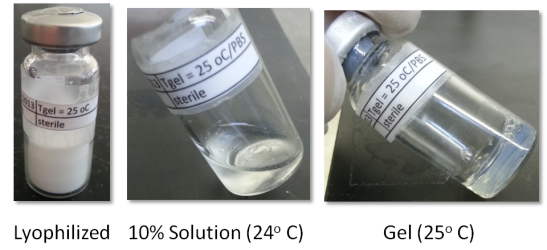
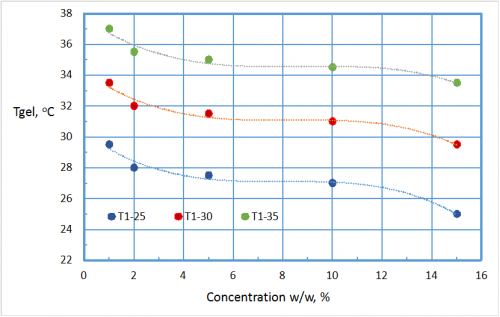
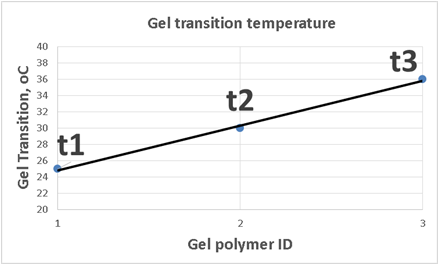
Poly(2,3)glucose forms temperature-responsive gels. Aqueous solutions are liquids below their lower critical solution temperature and hydrogels above their transition temperature. These physically cross linked gels have precise (+/- 0.5 C) transition temperatures. Poly(2,3)glucoses T1-25, T1-30, and T1-35 have transition temperatures of 25, 30 and 35 in phosphate buffered saline 0.01 M. By linearly blending the two products with transitions that bracket another temperature, any intermediate transition temperature can be attained and temperature shifts due to other diluents can be accomodated.
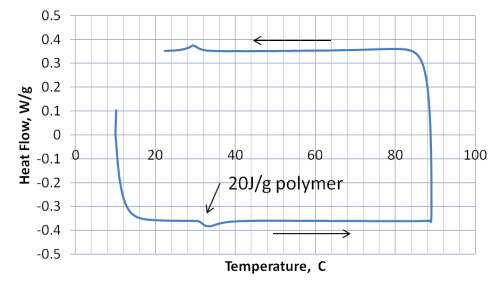
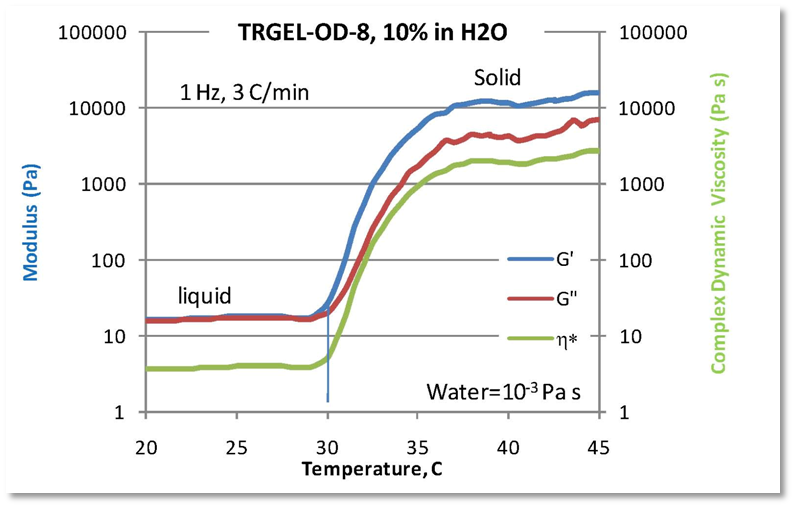
The viscoelastic properties of a poly(2,3)glucose solution change dramatically and abruptly at the transition temperature. The sol-gel transition is endothermic and entropic. The heat of transition is ~20 J/g of polymer. The liquid to gel transition is very rapid, while the gel to liquid transition is slower and displays hysteresis. Applications of temperature-responsive gels utilize this hysteresis. For example islet cells can be suspended in a 10% T1-25 solution at 24 C, encapsulated at 37 C, and then handled at 24 C for hours before they are implanted in a murine kidney capsule.
Entropic Transition