poly(2,3)Glucose™ Hydrogel Films
The best of PEO, alginate, and ePTFE
poly(2,3)Glucose™ hydrogel films can be cast and coated from T1-30-F dissolved in organic solvent. These hydrogel films swell in aqueous solutions, but they do not dissolve. They are permeable to aqueous solutes. T1-30-F is a branched version of the temperature responsive gel T1-30. While still physically crosslinked upon heating, additional branching alters material properties. T1-30-F has the same biocompatiblity as T1-30, but it does not dissolve in water at low temperature, and it has higher modulus and strength.
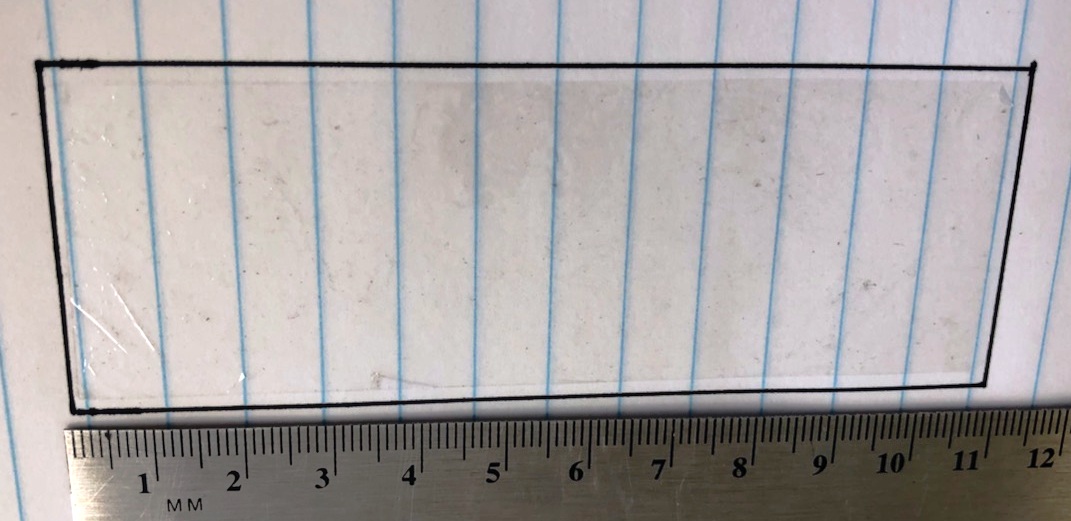
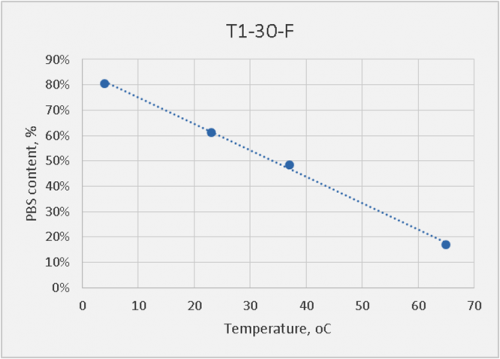
Below left is pictured a 3.5 x 11 cm x 20 micron semi-permeable membrane of T1-30-F cast from a 20 w/v% solution in dichloromethane. The dry film is similar to cellophane. In PBS at 37 C the hydrogel imbibes 50 wt% water and swells double in size. Aqueous absorption of the film increases with decreasing temperature as shown below. Below right is pictured a T1-30-F film holding 60 wt% water at room temperature. Its ultimate tensile strength (based on wet dimensions) is 1.3 MPa. Dichloromethane, tetrahydrofuran, and acetone are good solvents, while water, ethyl alcohol, and heptane are non-solvents. Dichloromethane is recommended for coatings associated with enzymes, since it will not disturb water layers adjacent to the protein.
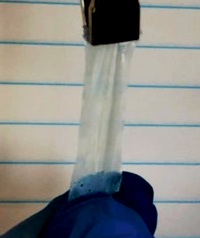
When the above membrane is soaked in 250 ppm methylene blue aqueous solution it becomes permanently stained, indicating permeability to small solutes. Once wet, additional water displays a zero contact angle with the hydrogel membrane. A 100 micron thick cast film was soaked in PBS for one week at room temperature and then tensile tested. The 1 cm wide test specimen is pictured below at 50% elongation, saturated with water at 30 C. The tensile strength is 0.3 MPa.
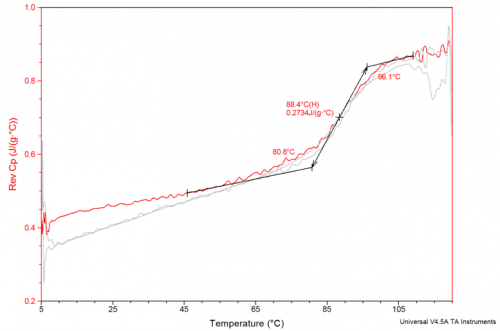
T1-30-F is heat processable. The calorimetry data below shows the glass transition temperature for dry material at 88 C. At about 140 C T1-30-F can be extruded, heat sealed, embossed, and laminated.
The processability of poly(2,3)Glucose™ semi-permeable hydrogel films can be exploited to limit foreign body response and improve vascularization for implanted devices. The foreign body response to implants protected by biocompatible materials depends critically on the surface topology. Approximately 1 micron diameter pores and surface roughness in expanded poly tetrafluoroethylene (ePTFE) have shown significant reduction in foreign body giant cell response and significant increase in vascularization [Nichols, 2013], enabling encapsulated allogenic transplants survival for one year [Tibell, 2001.] T1-30-F can, for example, be cast from dichloromethane and then immersed in ethyl alcohol to introduce macro porosity through phase inversion.
The temperature responsive nature of poly(2,3)Glucose™ semi-permeable membranes enables tuning of the molecular weight cut-off for aqueous solutes. The amount of water imbibed by the hydrogel at 37 C increases with the gel temperature of the membrane. For example a semi-permeable membrane made from the gel T1-25 would imbibe less water than T1-30-F. The amount of water held by the hydrogel controls its permeability and solute molecular weight cut-off.
When coating from solvent onto substrates that are softened by the solvent, a weld will form. For substrates not miscible with the coating solvent, bonding functionality can be incorporated directly in the polymer backbone. For example, glass can be coated by introducing silane groups to the polymer backbone. There are no small molecule radicals to introduce for in situ bonding to the device surface. Bonding can be important for maintaining adhesion when the hydrogel swells.
poly(2,3)Glucose™ provides unique control over surface topology, molecular weight cut-off, surface bonding, and processability. The lubricity and biocompatibility of hydrogel coatings are well known. Typical coatings employ either crosslinked hydrophilic polymers (polysaccharides like alginate, PVA, PEO, PVP, NIPAm or PU [Kamoun, 2017]) or hydrophilic polymers bound in a crosslinked, hydrophobic matrix [Hsu, 1999.] In situ cross-linking limits the performance of traditional hydrogels. poly(2,3)Glucose™ semi-permeable membranes meet this need.
Nichols, S.P., et al, “Biocompatible Materials for Continuous Glucose Monitoring Devices,” Chem Rev. 2013 April 10; 113(4).
Tibell, A.K., et al, “Survival of macroencapsulated allogeneic parathyroid tissue one year after transplantation in nonimmunosuppressed humans,” Cell Transplantation 10(7):591-9 · February 2001.
Kamoun, E.A., et al, “A review on polymeric hydrogel membranes for wound dressing applications: PVA-based hydrogel dressings,” J Adv Res. 2017 May; 8(3): 217–233.
Li-Chien Hsu, Can B. Hu, “Lubricious coatings for medical devices,” US6340465B1, 1999
Semi-permeable Membrane
Elastic Hydrogel
50% Porous Hydrogel
Heat Processable